All Lab Named "2025 Innovator of the Year" at LocWorld’s Process Innovation Challenge
AWARD · LOCWORLD54 · MONTEREY, CALIFORNIA
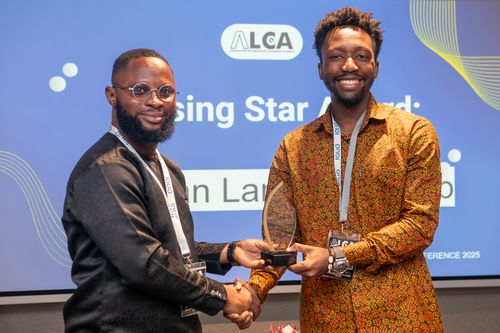
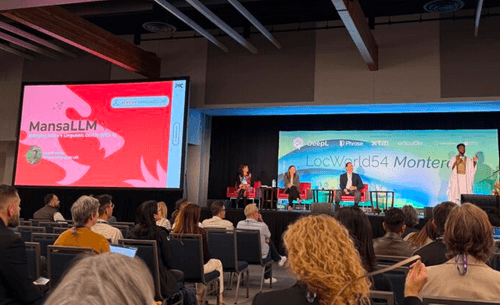
On October 15, 2025, in a room full of the people who decide how the world's content gets translated, the 19th Process Innovation Challenge named African Languages Lab the 2025 Innovator of the Year, USA. Our Founder and CEO, Sheriff Issaka, accepted it for MansaLLM. Africa's languages were not on the agenda of this industry a decade ago. Now they are the innovation it is celebrating.
Award: 2025 Innovator of the Year, USA · Event: 19th Process Innovation Challenge at LocWorld54 · Date: October 15, 2025, Monterey, California · Recognized for: MansaLLM, a unified AI model for African language translation and localization · Accepted by: Sheriff Issaka, Founder and CEO
A Billion People, Locked Out by Default
Ask an AI system a question in Yoruba, Twi or Amharic and watch what happens. Most of the time you get something confident and wrong, or nothing useful at all. Not because these languages are hard. Because nobody built for them.
Africa is home to more than 2,000 languages, close to a third of everything humanity speaks. Fewer than 3% of them show up in the AI systems now sitting between people and their banks, their schools, their governments and their markets. Over a billion people are expected to switch into somebody else's language just to use the tools everyone else takes for granted.
2,000+ languages spoken across Africa · 1 in 3 of the world's languages originate here · Under 3% are supported by modern AI
That gap has a price, and it gets paid every day:
- A student reads a textbook in a language she is still learning, while the concept she actually needed to understand slips past her in a language she already thinks in.
- A trader with customers in four languages can only sell online in one, because that is the only language the platform speaks.
- A health ministry publishes urgent guidance that reaches the cities and stops at the edge of them.
- A developer in Accra or Kano has the idea and the skill, but not a model that understands the people he would be building for.
Exclusion from AI is not a translation problem. It is an access problem, and it compounds.
So We Built the Model Nobody Else Was Going to Build
MansaLLM is a Large Language Model made for one job: translating and localizing African languages properly. Not a global model with African languages bolted on at the end, but a system designed around them from the first decision. It currently covers English and 20 key African languages, including Swahili, Yoruba, Hausa and Amharic.
What makes it work is not clever architecture. It is the data underneath it. We spent over a decade gathering high-quality, expert-validated language data, the kind that only exists if somebody goes and collects it, language by language, speaker by speaker. We could not outspend Silicon Valley, so we invested in the ecosystem instead.
What that buys you in practice
- Accuracy where other models fall apart. General-purpose systems struggle most with low-resource languages for a simple reason: they barely saw them. MansaLLM saw them properly.
- Consistency at volume. Terminology, tone and meaning hold steady across thousands of documents and months of work, which is the difference between a demo and a production system.
- One system, not twenty. A single unified framework covers every supported language, so teams stop maintaining a separate pipeline for each one.
Translators are not the ones being replaced here
The fear in this industry is well known and worth answering directly. MansaLLM takes the repetitive, high-volume work off a translator's desk. It does not take the judgement. Knowing that a phrase is technically correct but would land badly in Kumasi, or that a proverb needs rebuilding rather than translating, is not a task to automate. It is the reason the profession exists. The model handles scale. People handle meaning.
"We don't have to wait for inclusion. We can build it. For Africans, by Africans."
Sheriff Issaka, Founder and CEO, African Languages Lab
Where It Is Already Useful
- Business. Selling to African markets in the language the customer actually buys in, instead of defaulting to a colonial lingua franca and hoping it lands.
- Education. Putting learning material in front of students in the language they think in, which is the whole point of a textbook.
- Government. Getting public health and civic information to the people it was written for, accurately, where a mistranslation is not an inconvenience but a risk.
- Culture. Keeping oral and written traditions readable by the generation that comes next, rather than losing them to a language shift nobody chose.
This Is the Milestone, Not the Destination
An award from LocWorld means the industry is paying attention. Good. But 20 languages out of 2,000 is a start, and we know exactly how far there is to go. The work is to keep building until asking a question in your own language stops being a feature and starts being normal.
Want to use MansaLLM, or build something with us? Talk to our team.
%20(1).png)